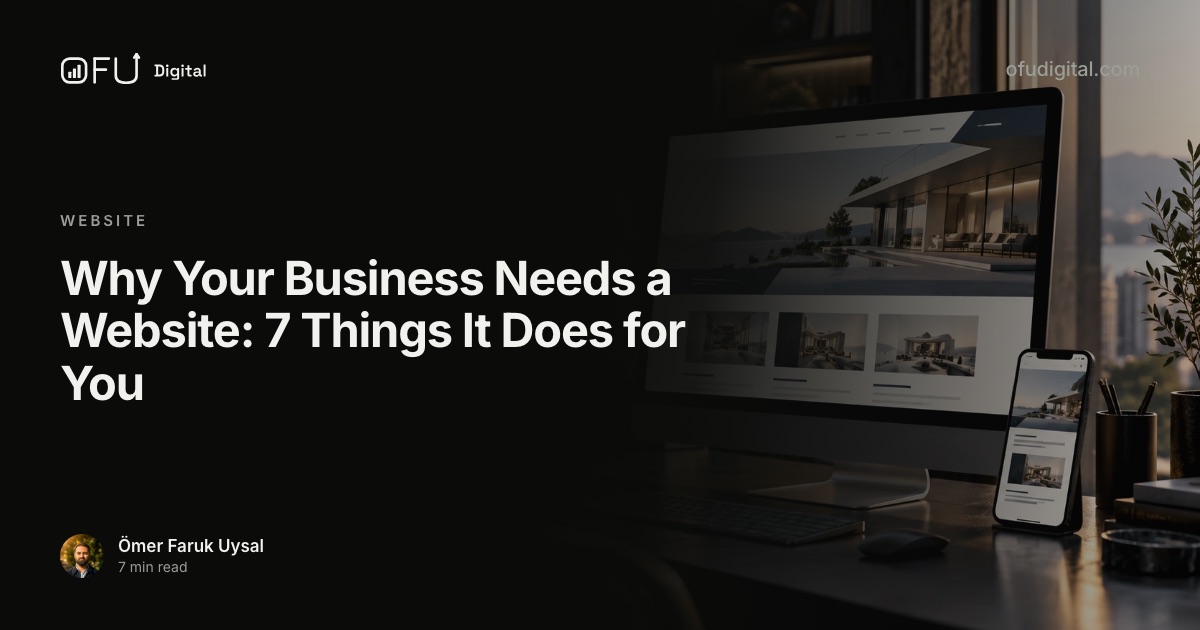
When someone hears about your business today, the first thing they do is pull out their phone and google you. The real question is what they find: an up-to-date, fast website — or nothing at all?
The short answer: a website is the one address on the internet you actually own. It builds trust, makes you findable on Google, takes enquiries around the clock — and unlike social media, you set the rules. The details and reasoning follow below.
Global digital usage data shows that the vast majority of consumers research online before buying a product or trying a service. If you don’t have a website, you’re simply not part of that research. And when potential customers can’t find you, they don’t call you — they call the competitor they could find.
In this post I’ll explain, in plain English, why a professional website does so much for your business. No jargon, no sales pressure — just what you need to know while growing your company.
Why a website matters: 7 concrete reasons
1. First impressions now happen online
Customers used to walk through your door, look at your shop window and make up their mind. Today that judgement is formed on a screen — often before you even know they exist. A tidy, current website says “this business takes its work seriously”. No website, or one last touched years ago, says the opposite.
2. A shop window that never closes
Your business closes in the evening; your website doesn’t. Someone researching you at midnight can browse your services, get a feel for pricing and leave an enquiry. Your website is the only thing that keeps working for you while you sleep.
3. It builds trust
When someone searches your name and finds nothing, the first thought is: “Is this business even real?” A full address, phone number, photos, reviews and clear service descriptions add up to trust — and trust is the first step of every buying decision.
4. It gets you found on Google
People take their needs straight to Google: “accountant near me”, “dental clinic prices”, “carpenter for fitted wardrobes”. Without a website, you appear in none of those searches. A well-structured site puts you in front of exactly the people already looking for you. A free Google Business Profile helps with local visibility too — but it only reaches full strength when it has a proper website to send people to.
5. Your competitors are already there
While you’re still weighing it up, your competitor has built their site, become visible on Google and welcomed the customers who were searching for you. Staying invisible online is not a neutral choice — it’s handing the field to the competition.
6. You stay in full control
On social media, someone else writes the rules: the algorithm changes, reach collapses, accounts get suspended. Your website belongs to you. What appears, where and how is entirely your call.
7. Everything is measurable
You can see how many people visit your site, which pages they read and how they found you. That means you steer your marketing budget by real data instead of gut feeling. The foundation is proper tracking — I’ve covered how to set up the Meta Pixel step by step, and how to work out what your advertising really returns.
Isn’t a social media profile enough?
I hear this question a lot, and it’s a fair one. My answer is a comparison: a social media profile is a rented shop; a website is property you hold the deeds to.
In a rented shop, the landlord makes the rules. If Instagram or Facebook changes its algorithm tomorrow, the number of people who see your posts can drop overnight. If your account gets restricted by mistake, years of followers become unreachable. And on social media, customers don’t see you — they see whatever the feed decides to show them.
Here’s the difference at a glance:
| Criterion | Social media profile | Your own website |
|---|---|---|
| Ownership | The platform’s | Yours |
| Rules | Set by the platform, changed without notice | Set by you |
| Reach | Depends on the algorithm | Google search + direct visits |
| Risk of losing it | Real, with an unclear appeals process | None, as long as the domain is yours |
| Appearance | Same template as everyone else | Built around your brand |
None of this makes social media pointless — quite the opposite: the two work together. Social media attracts attention; your website turns that attention into customers. Someone who likes your post looks for a reliable address with the full details before deciding. That address is your website. If you want to strengthen the social side too, my Instagram content ideas are a good place to start.
A slow website loses customers
Having a website doesn’t automatically mean doing it right. A page that takes seconds to load, or breaks on a phone, can do more damage than having no site at all — because visitors transfer that bad experience directly onto your business.
Two things matter most:
- Speed: Visitors are impatient. If your page doesn’t open within a few seconds, most people leave and don’t come back. Google also ranks slow sites lower — so speed is both customer experience and visibility.
- Mobile: Most visitors now arrive on a phone. Anyone who has to pinch and zoom to read will simply close the tab. A site that isn’t flawless on mobile is an unfinished site.
You can test how your site currently performs in under a minute with Google’s free PageSpeed Insights.
That’s exactly why I build websites that don’t just look good, but load fast and work cleanly on every device.
Selling in Germany or the EU? Mind the legal pages
One point that catches many English-speaking businesses off guard: if you operate in Germany or serve EU customers, your website needs proper legal pages — a legal notice (in Germany: the mandatory “Impressum”) and a GDPR-compliant privacy policy, including a cookie banner that only starts tracking after consent. In Germany, missing legal pages are a common trigger for costly warning letters.
This isn’t a reason to worry — it’s part of any properly run website project. Whoever builds your site should handle these pages from day one. If in doubt, ask directly; the answer tells you a lot about the provider.
Can you actually get to the top of Google?
Yes — but not by magic. It’s the sum of work done properly, and it’s called SEO (search engine optimisation). The logic is simple: Google wants to show its users the most helpful, most trustworthy page. Your job is to convince Google that page is yours.
The main building blocks:
- Well-structured pages: Every page needs a clear title and a single topic. Instead of one generic “Services” page, give each service its own page — it multiplies your chances of appearing in the right searches.
- Name your area: Customers usually search “city + service”. Stating clearly where you work puts you in exactly those searches.
- Speed and mobile: The technical basics from the previous section feed straight into rankings.
- Regular content: Articles that answer your customers’ real questions make your site valuable to Google and to visitors — like the one you’re reading right now.
And to be honest with you: SEO is not a one-off task; it’s a process that plays out over months. The upside is that the visibility you earn doesn’t vanish when a budget runs out — unlike ads. When you need results faster, paid advertising complements search well; I’ve compared when Google Ads or Meta Ads makes sense in a separate post.
How much does a website cost?
There’s no single answer, because “a website” isn’t a single product. A one-page landing site and an online shop with dozens of products are entirely different projects. The price is driven by the number of pages, how custom the design is, extra features like booking or payments — and who produces the content.
| Type of website | Typical scope | Best for |
|---|---|---|
| One-pager / landing page | 1 page, contact form | Single-offer businesses, campaigns |
| Company website | 5–15 pages, blog, multilingual if needed | Service businesses, clinics, firms |
| Online shop | Product catalogue, payments, shipping | Anyone selling online |
The most important warning: the cheapest quote usually turns out to be the most expensive. A template with your logo dropped in tends to load slowly, never shows up on Google, and has to be rebuilt within a year or two. Doing it right once is cheaper than doing it twice.
Before you sign anything, ask three questions:
- Will the website belong to me? (The domain and the site itself must be registered in your name.)
- Who handles maintenance and updates after launch — and on what terms?
- Are speed, mobile performance and the required legal pages guaranteed — and how will you prove it?
A provider without clear answers to these is too expensive at any price.
Frequently asked questions
How long does it take to build a website?
A one-pager with ready content can go live within a few weeks. Multi-page company sites and shops take longer depending on scope. The biggest factor is almost always when the text and images are ready.
Can I update the website myself?
Yes. If you prefer, I build the site so you can update prices, news and blog posts yourself. Or I take care of ongoing updates for you — entirely your choice.
What is a domain, and who owns it?
The domain is your address on the internet (for example, www.yourcompany.com). When we work together, it’s registered in your name — so your address remains your property no matter what.
Will my site rank at the top of Google right away?
No — and nobody can honestly promise that. Rankings are earned over months. I build the site on the right technical foundation with search-ready content; visibility then grows with consistent work.
Are there ongoing costs?
Modest ones: the domain and hosting renew annually. I put these costs and what they cover on the table from day one — no surprise fees later.
Take the first step
To sum up: a website isn’t a nice-to-have — it’s your business’s working presence on the internet. Your customers are looking for you there, and when they can’t find you, they find your competitors.
If you don’t know where to start, that’s fine; the starting point isn’t technical knowledge — it’s a short conversation. You’ll find the scope of my web design work on the services page, and you can reach me for a free, no-obligation chat via the contact page. Talking commits you to nothing — the decision is always yours.
Ready to grow your brand?
On a free strategy call we look at where you stand, together.
Free strategy call →
Five years inside Meta's advertising ecosystem working with its largest advertisers: analysing the business, building a strategy around it and setting up the advertising structure end to end. Now founder of OFU Digital.
Related posts
SEO vs AEO vs GEO: What's the Difference and What Matters?
SEO targets rankings, AEO the answer box, GEO AI citations. How they differ, what Google officially says, and what boosts visibility by up to 40%.
Instagram Content Ideas for Brands: Turning Engagement Into Free Reach
A profile run like a brochure earns nothing. Content ideas sorted by what you want people to do, why even the smallest tap counts, and what organic engagement is worth to your Meta ads.
Google Ads vs Meta Ads: Which Channel Fits Your Business
The question isn't which channel is better — it's where your customers currently stand. Capturing demand or creating it: that's what decides it.